



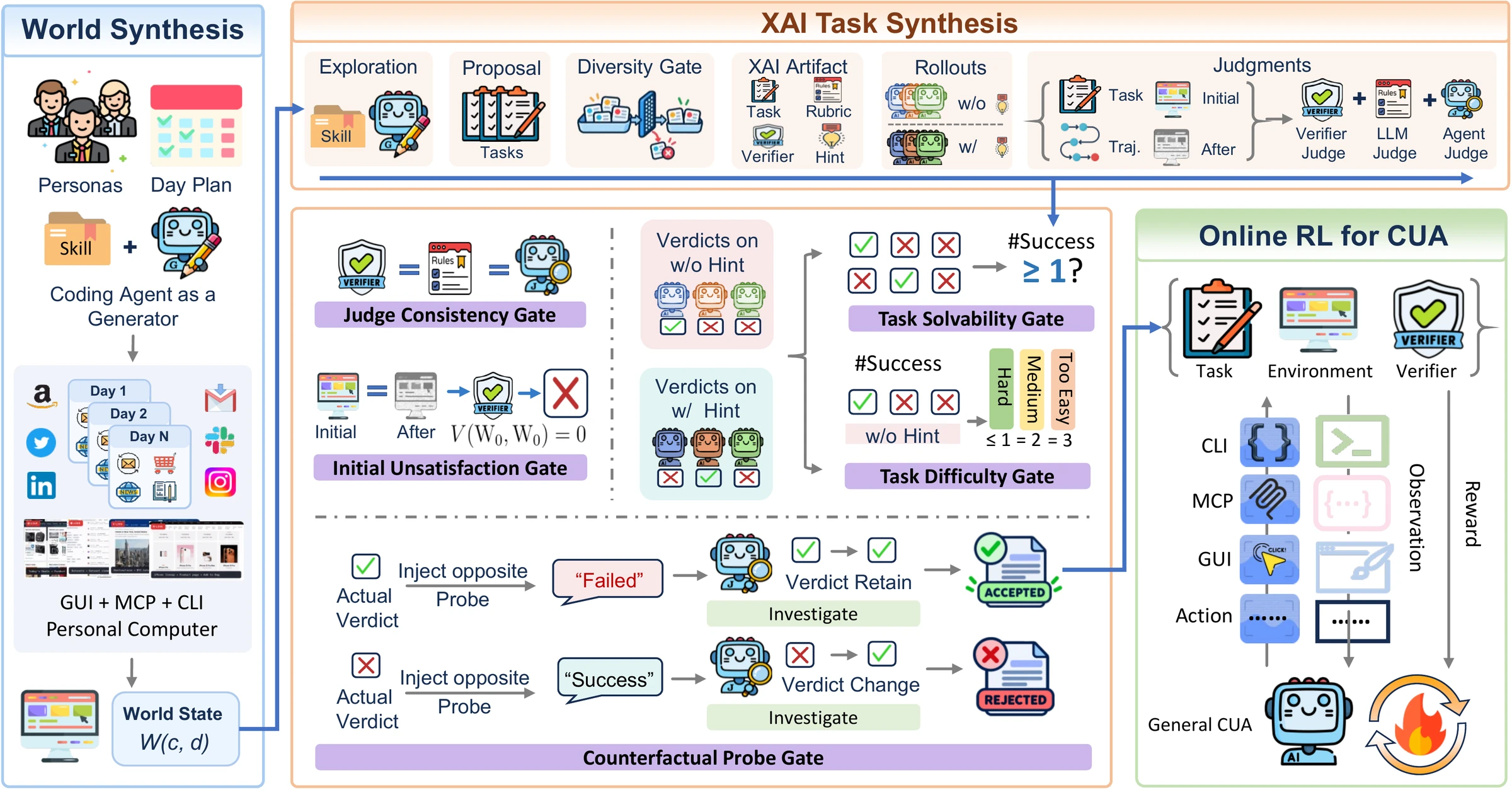
Overview
Computer-use agents increasingly learn by acting in executable environments. Real computers are a poor place to do that: their state is hard to reset, online services drift, and exploratory actions can have real consequences. Synthetic environments restore control, but most pipelines build a single interface at a time, such as the browser, tool calls, or the terminal.
WildAWM synthesizes a whole personal computer for each persona, one day at a time, so websites, MCP services, and local files share one evolving state. It then writes cross-interface (XAI) tasks grounded in these worlds and keeps only those that pass five execution-based quality gates. The entire pipeline is powered by open-source models, without any proprietary models.
- 341 long-horizon tasks. Some take over 100 agent steps, and GPT-6-Astra reaches only about 60% pass@1.
- Transfer to unseen benchmarks. Qwen3.6-35B-A3B and Qwen3.5-4B trained only in WildAWM worlds improve on all eight out-of-distribution benchmarks: web agents (Online-Mind2Web, WebArena), claw agents (QwenClawBench, ClawEval), and computer-use agents (CUA-Gym, OSWorld-Verified, OSWorld 2.0, Agents’ Last Exam). They gain +10.58 and +8.21 points on average.
- Open-source end to end. Synthesis runs on three open-source models and six agent harnesses, without relying on any proprietary models.
Method
Two stages produce the data. World synthesis grows a persona's computer day by day; task synthesis turns one day's world state into verified cross-interface tasks. Select a step.
Persona
A coding agent writes each persona from scratch: an occupation, named contacts, frequently used websites, and storylines that run across several days. Candidates too similar to accepted personas are regenerated with feedback.
- Personas
- 36
- Websites per persona
- 3–15
- MCP services per persona
- 4–8
Day plan
Plans are written one day at a time. Before planning day d, the agent inspects the actual world state W(c, d−1), so activities pick up where they left off. Each plan lists the people, applications, databases, and files involved.
- Days per persona
- 8–30
- World states
- 640
Build the day
The agent reuses event skills and services from a shared library, adds new ones when a plan needs them, and writes a deterministic program that updates databases, websites, and files. A day is kept only if two replays produce the same state and every service stays healthy.
- Reusable event skills
- 83
- Mirrored websites
- 15
- MCP apps
- 8
Snapshot
Each accepted day is saved as a world state W(c, d), which initializes and resets the environment. History accumulates, so later days hold the messages, records, and files of every earlier day.
- Database records, final day
- 171.6K
- Local files, final day
- 50.1
- World state size, final day
- 59.3 MiB
Propose
From a world state, the generator explores the live environment and proposes tasks that need all three interfaces. A diversity gate keeps the proposals least similar to accepted tasks, and each task ships with a verifier, a rubric, and a hint.
Example, task 16bfe8-d8-h1
“I'm finalizing race-day kit for the Austin Half Marathon on 2027-02-21 and want to re-check the running-watch decision before race morning.”
- MCPcalendar
- CLIre-rank
- GUIAmazon cart
- CLIlog
- MCPmessage
Roll out
Heterogeneous agents attempt every task: six rollouts, half with the hint, drawn from 18 model–harness pairs. Success counts become evidence of solvability and difficulty.
- Models
- GLM-5.2, DeepSeek-V4-Flash, MiniMax-M3
- Harnesses
- OpenCode, Codex, Claude Code, Nanobot, OpenClaw, Hermes Agent
Judge
Each rollout receives three verdicts: from the synthesized verifier, from an LLM judge that reads the task, rubric, and trajectory, and from an agent judge that inspects the world before and after.
- During RL
- Only the programmatic verifier is kept, as the reward.
Gate
Five quality gates turn the evidence into a decision. Failing candidates return to the generator with diagnostics for up to two revision rounds; the gates and their effect are below.
- Acceptance rate
- 53%
- Rollout success, no hint
- 21.3%
Five quality gates
A candidate becomes a task only if it passes all five. Of 2,551 proposal sketches, 341 are accepted, and 304 of those pass only after feedback-driven revision. Training Qwen3.5-4B on data synthesized with one gate removed lowers its average score by 2.60–9.30 points. Select a gate in either panel.
Candidates through the gates
Loading the candidate progression…
Score with one gate removed
Loading the gate study…
Dataset
Tasks are long and keep switching interfaces: a task has 4.2 sub-tasks and 3.1 interface switches on average, and 74.5% return to an interface used earlier, so an agent must carry state from one interface to the next.
- Personas
- 36
- World states
- 640
- Tasks
- 341
- Hard / medium
- 273 / 68
- Websites / MCP apps
- 15 / 8
Download all 341 tasks from Hugging Face, or run them with Harbor.
Tasks per persona
Loading the chart…
Explore the validation tasks
The 33 released validation tasks. Select a bar to filter the table, and open a row for its interface flow and exact instruction.
Difficulty
Website
MCP domain
Interface hops
| Loading tasks… | ||||
Results
Trained only in WildAWM worlds, both Qwen models improve on all eight out-of-distribution benchmarks, across web, claw, and computer-use agents. Both checkpoints are on Hugging Face: WildAWM-35B-A3B and WildAWM-4B.
- Qwen base
- WildAWM 35B-A3B
- WildAWM 4B
- GPT-6-Astra
| Loading… |
Pass rate for O2W, WA, and CLE; mean score for the others. Table rows marked † are numbers reported in the official papers.
- Larger models gain more. The 35B-A3B model improves most on ClawEval (+16.67), OSWorld-Verified (+16.06), WebArena (+13.72), and CUA-Gym (+12.22).
- The gap to frontier models narrows. The 35B-A3B average rises from 42.84 to 53.42; it matches GLM-5.2 on WebArena (67.26) and exceeds GPT-5.5 on Online-Mind2Web (80.77 vs. 72.22).
Findings
-
Hard, yet solvable
GPT-6-Astra reaches about 60% pass@1 on the validation tasks and still fails 27.3% of them after eight attempts. Yet every task is solved by at least one of 24 model–harness agents.
-
Verifiers agree with judges
On 100 sampled rollouts, the synthesized verifier matches the majority verdict of agent judges 95% of the time, with Cohen's κ of 0.90.
-
Richer, more diverse worlds
A WildAWM environment state has a median of 52.4K tokens, against 1.1K for CUA-Gym, and it still scores higher Vendi diversity at every sample size.
-
Synthesis keeps scaling
Accepted tasks reach 134 domains and 91 task types at a 53% acceptance rate, without clear saturation.
-
SFT teaches switching, RL teaches persistence
Fine-tuning on GLM-5.2 trajectories raises the interface-switch rate from 18.4% to 24.7%. RL then adds long-horizon solving: between 40 and 120 steps, the share of solved tasks grows by 17.0 points for WildAWM, against 9.7 for SFT alone.
-
Gains stay within the teacher's reach
Splitting the out-of-distribution tasks into difficulty quartiles, WildAWM gains most on the middle two (+19.9 and +12.2 points). On the hardest quartile, no variant gains clearly.
Examples
Solved trials on released validation tasks, replayed step by step. Each step lists its tool calls, colored by interface; open a step for the arguments and results.
Loading the viewer…
Trajectories come from Harbor runs of the released tasks. Long tool outputs are trimmed, and values typed into password fields are redacted.
Citation
@article{wang2026agentworldmodelwild,
      title={Agent World Model in the Wild: Computer-Use Agent Environment Synthesis},
      author={Zhaoyang Wang and Qianhui Wu and Haorui Wang and Simon Yu and Baolin Peng and Canwen Xu and Hao Cheng and Wenlin Yao and Boyi Liu and Yite Wang and Jianfeng Gao and Huaxiu Yao},
      year={2026},
      eprint={2610.26828},
      archivePrefix={arXiv},
      primaryClass={cs.AI},
      url={https://arxiv.org/abs/2610.26828},
}